Learn how scalers and periodontal curettes differ, where each one is used, and how to choose the right instruments for your practice.
Dental scalers and curettes are essential instruments for dental professionals during periodontal cleaning procedures. Both help remove plaque, tartar and deposits from tooth surfaces, but their designs, working ends and clinical applications are different.
Understanding dental scalers vs. curettes helps hygienists and practitioners pick the right instrument for effective cleaning and periodontal care. In this guide, we cover the types of dental scalers and curettes, their uses, key differences and how to choose and maintain them.
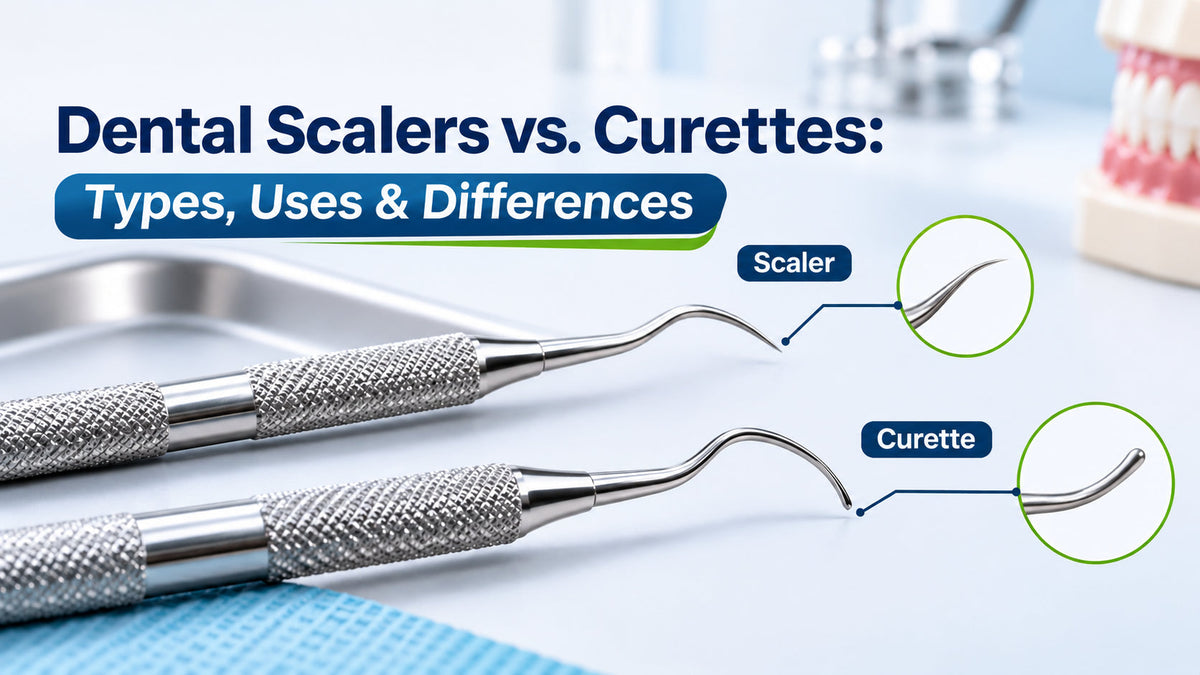
Dental scalers are hand instruments designed to remove plaque, calculus and other deposits from tooth surfaces. They are commonly used in professional cleanings, particularly for removing supragingival calculus, which is the deposit found above the gumline.
Most traditional scalers have sharp working edges and pointed tips that help clinicians reach different tooth surfaces.
Common Types of Dental Scalers
Sickle Scalers
A pointed tip and a triangular cross-section with two cutting edges. Suitable for moderate to heavy supragingival calculus, and used on anterior and posterior teeth depending on the design.
Straight Scalers
A straight working end made for accessing specific tooth surfaces. Useful where their shape gives suitable access to deposits.
Periodontal Scalers
Built for professional calculus removal, with different working-end shapes to meet specific clinical requirements.
Periodontal curettes remove subgingival calculus, plaque and contaminated deposits from tooth roots and periodontal pockets. Unlike sickle scalers, curettes generally have a rounded toe and rounded back, which makes them suitable for instrumentation below the gumline when used correctly.
They are also used for root surface debridement and other periodontal cleaning procedures.
Common Types of Periodontal Curettes
Universal Curettes
Versatile instruments that adapt to multiple tooth surfaces. Both cutting edges of the working end can be used, so one instrument covers different areas of the mouth. Commonly chosen for general scaling and root debridement.
Gracey Curettes
Area-specific instruments designed for particular tooth surfaces and regions. Their design helps clinicians reach challenging root surfaces during periodontal treatment.
Mini and Extended Shank Curettes
Mini-bladed curettes have shorter blades for narrow or deeper pockets. Extended-shank curettes have longer shanks to reach deeper periodontal areas.
Gracey Curette Numbers and Where They Are Used
- Gracey 1/2 and 3/4: anterior teeth
- Gracey 5/6: anterior teeth and premolars
- Gracey 7/8: posterior teeth, buccal and lingual surfaces
- Gracey 11/12: posterior teeth, mesial surfaces
- Gracey 13/14: posterior teeth, distal surfaces
The right choice depends on the patient's periodontal condition and the clinician's treatment approach.
Both instruments remove dental deposits, but their working-end designs and applications are not the same.
| Feature | Dental Scalers | Periodontal Curettes |
|---|---|---|
| Main purpose | Removing calculus and deposits | Removing subgingival calculus and root deposits |
| Tip design | Often pointed | Rounded toe |
| Cross-section | Sickle scalers are triangular | Generally semicircular or rounded |
| Cutting edges | Commonly two | Two on universal curettes, one on area-specific Gracey curettes |
| Primary application | Mainly supragingival scaling | Supragingival and subgingival instrumentation |
| Common types | Sickle and straight scalers | Universal and Gracey curettes |
Sickle Scaler vs. Gracey Curette
Sickle Scaler
- Pointed working tip
- Triangular cross-section
- Mainly for supragingival calculus
- Used on accessible tooth surfaces
Gracey Curette
- Rounded toe and rounded back
- Area-specific working end
- Designed for subgingival instrumentation
- Available in patterns for specific surfaces
Choosing between them depends on where the deposits are located and what the procedure requires.
Selecting suitable periodontal instruments supports efficient cleaning and patient comfort. Consider these factors:
- Type of deposits: sickle scalers are commonly used for supragingival deposits, while curettes are designed for periodontal instrumentation.
- Tooth anatomy: different surfaces need different designs, and area-specific Gracey curettes help reach particular root surfaces.
- Instrument design: look for suitable working-end geometry, comfortable handles and the right shank length for better control.
- Quality materials: choose durable, corrosion-resistant instruments that suit repeated cleaning and sterilization as per manufacturer instructions.
- Ergonomics: a comfortable handle improves grip and control and can reduce hand fatigue during long procedures.
Proper maintenance protects instrument performance, durability and safe clinical use. Follow these general practices:
- Clean instruments promptly after use according to manufacturer instructions.
- Inspect working ends for damage, corrosion or wear.
- Use appropriate cleaning methods and compatible detergents.
- Follow the validated sterilization instructions for each instrument.
- Store sterilized instruments in suitable packaging or instrument cassettes.
- Check cutting edges regularly and sharpen when required, following manufacturer recommendations.
Good instrument care maintains working-end performance and supports infection prevention protocols in your practice.
Choose Quality Periodontal Instruments for Your Practice
Scalers and curettes are everyday tools for dental hygiene and periodontal procedures. Well-manufactured instruments support consistent clinical performance, comfortable handling and reliable maintenance.
At Fortec, dental professionals can explore a range of instruments and supplies for their clinical needs. When selecting periodontal instruments, consider working-end design, material quality, ergonomics and compatibility with your cleaning and sterilization processes.
Explore Fortec's dental instruments and periodontal instruments to find suitable products for your practice.
What is the main difference between dental scalers and curettes?
Dental scalers are mainly used to remove supragingival calculus, while periodontal curettes are designed to remove deposits from tooth roots and periodontal pockets.
Are dental scalers used below the gumline?
Traditional sickle scalers are mainly intended for supragingival scaling. Subgingival instrumentation is generally done with periodontal curettes or other instruments designed for that purpose.
What is the difference between universal and Gracey curettes?
Universal curettes adapt to multiple tooth surfaces, whereas Gracey curettes have area-specific working ends designed for particular tooth surfaces.
Which Gracey curette is used for posterior teeth?
Gracey 7/8, 11/12 and 13/14 are commonly used on posterior teeth. The choice depends on the specific tooth surface being treated.
How often should dental curettes be sharpened?
It depends on how often the instrument is used, its material and the manufacturer's recommendations. Inspect cutting edges regularly and sharpen when necessary.
Can dental scalers and curettes be sterilized?
Yes. Reusable scalers and curettes should be cleaned, inspected, packaged and sterilized according to the manufacturer's validated instructions and applicable infection prevention guidelines.
Dental scalers and curettes both play important roles in professional cleaning and periodontal care. Scalers are primarily designed for supragingival calculus removal, while curettes offer specialized designs for subgingival instrumentation and root surface debridement.
Knowing the differences helps dental professionals choose the right instrument for each clinical situation. With quality periodontal instruments and proper maintenance, practices can support effective cleaning, longer instrument life and safe patient care.
Explore Fortec's periodontal instruments collection to find products that support your periodontal care needs.