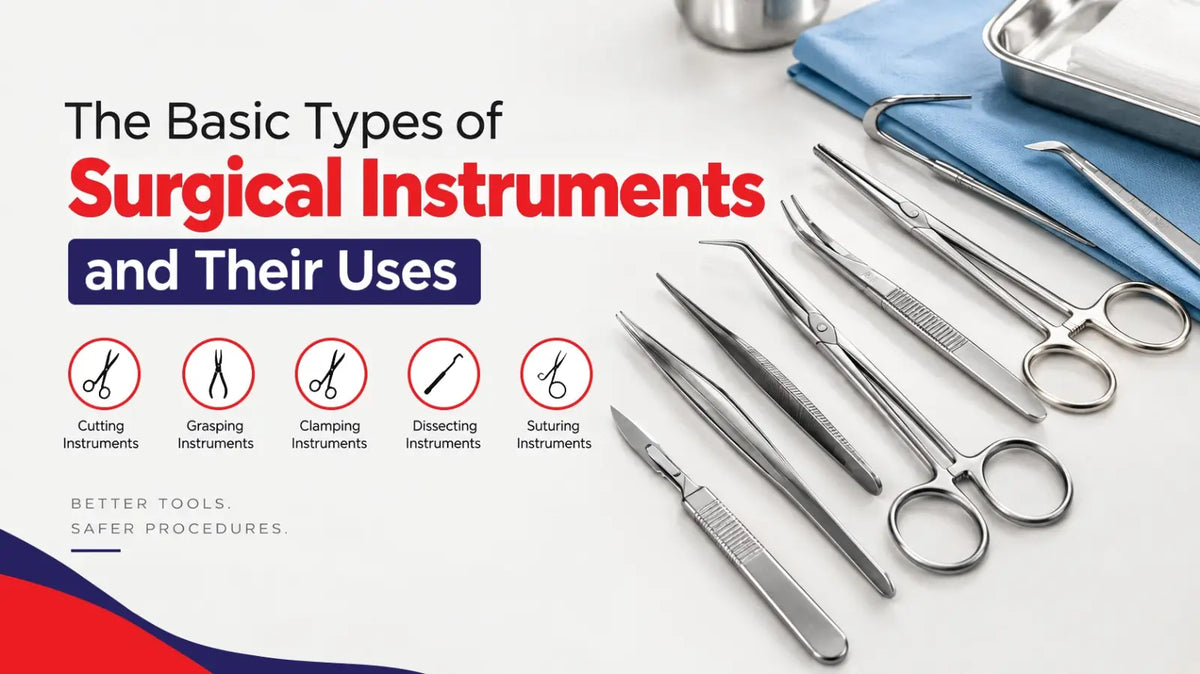
Surgical Instruments and Their Uses
Every tool on the surgical tray, explained by category — what it does, when it is used, and why the right choice matters for outcomes.
A dental surgical tray at a clinic contains many metal tools. But each instrument has a specific job. The key is to know the basic types so your tray makes sense — and so every item on it is there for a reason.
Whether you are setting up a new clinic or upgrading an existing one, understanding the basic types of dental surgical instruments and their uses will help you choose and buy tools that match your actual clinical needs.
Examination and Diagnostic Tools
Before any surgery starts, the dentist needs a clear view and accurate assessment of the site. A standard exam kit includes a mouth mirror, a probe, and tweezers (also called cotton pliers).
Mouth Mirror
Lets the dentist see behind teeth and around corners. The angled mirror head reflects light into areas the direct line of sight cannot reach — posterior surfaces, palatal aspects, and the floor of the mouth. Essential for every exam and most procedures.
Periodontal Probe
Checks gum pockets and feels for problems under the gumline. Calibrated markings let the clinician measure pocket depth in millimeters — a key diagnostic data point before any periodontal or surgical intervention.
Cotton Pliers (Tweezers)
Picks up small items and places cotton rolls, gauze, or restorative materials with precision. Locking and non-locking patterns are available depending on whether hands-free holding is needed during the procedure.
These are the highest-use tools in any practice. Fortec keeps them in stock because no clinic can run without them. They belong on every exam tray, every day.
Tools That Loosen the Tooth: Elevators and Luxators
When a tooth needs to come out, the dentist first loosens it before applying forceps. That is the job of dental elevators and tooth luxators. These thin instruments go between the tooth and the surrounding bone, cutting the periodontal ligament fibers and gently creating space. This lets the tooth come out with less force — and less trauma to adjacent bone and tissue.
- Straight elevators: Good for initial loosening and creating space around the tooth before forceps placement. Applied with a rotational or lever motion.
- Luxating elevators: Have a thin, sharp blade that cuts the periodontal ligament fibers and wedges between the root and alveolar bone. Designed to be inserted into a narrow space.
- Cryer elevators: Have a sharp point and a triangular blade. Work well for removing the roots of lower molars, particularly when the crown is fractured or absent.
Fortec carries standard elevators and luxating elevators in sizes 2 mm, 3 mm, 3.5 mm, and 4 mm, in both straight and curved configurations.
Browse Fortec's complete collection to find extraction forceps, elevators, rongeurs, scissors, and complete surgical kits.
Contact Us to Start with a Free Quote →Tools That Remove the Tooth: Extraction Forceps
Forceps grip the tooth and remove it from the socket once it has been loosened. They are designed for different teeth and different parts of the mouth — using the wrong pattern for the arch or tooth type increases the risk of fracture and bone damage.
Upper (Maxillary) Forceps
For maxillary teeth — the beak is angled relative to the handle to allow correct approach when the patient's mouth is open and the upper arch is accessible from above.
Lower (Mandibular) Forceps
For mandibular teeth — the beak lines up with the handles, allowing the surgeon to approach from above while directing force toward the lower arch.
Cowhorn Forceps
Grip lower molars at the furcation between roots. Can also help section a multi-rooted molar into pieces for staged removal when a single-piece extraction is not possible.
Using the right dental extraction forceps for the right tooth protects nearby bone and tissue. Fortec offers a full range of upper and lower extraction forceps for all quadrants, in both adult and pediatric patterns.
Tools for Bone: Rongeurs, Bone Files, and Chisels
Sometimes the bone needs reshaping after a difficult extraction or in preparation for a denture or implant. Three instruments handle this work at different stages:
Rongeurs
Rongeurs remove small bites of bone with a spring-loaded jaw mechanism. They trim and contour the alveolar ridge during alveoloplasty, working in a biting motion that takes controlled, repeatable increments of bone with each squeeze.
Bone Files
Bone files smooth sharp edges and rough surfaces after rongeur work. A pulling motion across the bone surface rasps down irregularities and creates a smooth, atraumatic ridge that will not irritate overlying soft tissue after closure.
Bone Chisels
Bone chisels make controlled cuts in bone for reshaping or implant site preparation. Used with a mallet, they allow precise splitting or sectioning of bone with a controlled fracture plane.
Fortec stocks Cleveland rongeurs, bone files, and bone chisels so a clinic can handle bone contouring in-house without sourcing instruments from multiple suppliers.
Soft Tissue Tools: Periosteal Elevators, Retractors, and Scissors
Surgery is not only about teeth and bone. The gums and soft tissue need careful, controlled handling throughout every procedure.
Periosteal Elevators
Periosteal elevators lift and reflect the gum flap so the dentist can access the underlying bone. The Molt 9 is the most common pattern for this. The instrument slides between the periosteum and the bone surface, lifting tissue cleanly without tearing.
Retractors
Retractors hold the cheek, lip, or tongue out of the surgical field. A clear, unobstructed view reduces the risk of accidental damage to nearby tissue and allows the surgeon to work with both hands on the procedure.
Surgical Scissors
Different scissor patterns serve different functions in the surgical field:
- Goldman-Fox scissors trim gum tissue and make incisions in the interdental area.
- Suture scissors cut suture thread cleanly without pulling the suture through tissue.
- Metzenbaum scissors are for delicate soft tissue dissection in deeper surgical fields.
- Fortec also carries crown and gold scissors for cutting crowns and metal restorative materials during removal procedures.
Bleeding Control and Suturing: Hemostats and Needle Holders
Bleeding control keeps the surgical site clean and the procedure safe. Two instrument types handle this stage of the workflow.
Hemostats
Hemostats clamp small blood vessels and soft tissue to control bleeding. Curved Kelly hemostats are common for clamping in deeper areas, while straight patterns work well for surface tissue. The locking ratchet mechanism holds the clamp in place without continuous hand pressure.
Needle Holders
Needle holders grip the suture needle and guide it through tissue during wound closure. A good needle holder holds the needle firmly at the correct angle without allowing rotation during the pass. The cross-hatched jaw pattern is what distinguishes a needle holder from a hemostat of similar size.
Fortec supplies Kelly curved and straight hemostats, plus needle holders, as part of its surgical instrument range.
Fortec supplies Kelly curved and straight hemostats plus needle holders as part of its surgical range. Email us and we will answer all your queries.
Email Us →Why the Material and Sterilization Matter
Most dental surgical instruments are made from surgical-grade stainless steel. This material resists corrosion and withstands repeated high-temperature autoclave cycles without degrading in performance or structural integrity.
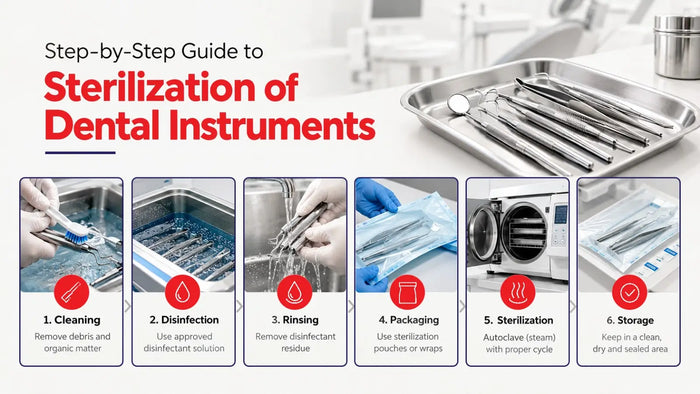
A simple sterilization routine protects the instrument and the patient:
- Clean the instrument soon after use — do not allow blood or tissue to dry.
- Rinse and dry it fully before packaging.
- Inspect for damage, corrosion, or wear — remove any compromised instrument from service.
- Lubricate hinges and locking mechanisms if needed before the autoclave cycle.
- Run a validated steam autoclave cycle with correct time, temperature, and pressure.
- Store sealed and dry in a cabinet until the moment of patient use.
In Canada, dental instruments are regulated by Health Canada as medical devices. Clinics must use instruments that are authorized for sale in Canada. Suppliers and importers should hold a Medical Device Establishment Licence (MDEL). Fortec supplies Canadian dental practices with instruments supported by compliance documentation that meets Canadian regulatory requirements.
Conclusion
The basic types of surgical instruments and their uses follow a clear clinical logic: see the site, loosen the tooth, remove the tooth, manage bone, handle soft tissue, control bleeding, and close the wound. When you know the clear purpose of each tool, the tray becomes easier to manage, easier to stock, and easier to use confidently during a procedure. If you have a clinic in Canada, the next step is simple — check your existing collection against these categories. If a tool is missing or worn, replace it before the next procedure.
Frequently Asked Questions
What is the difference between an elevator and a luxator?
An elevator uses lever force to loosen the tooth and expand the socket. A luxator has a thinner, sharper blade designed to cut the periodontal ligament fibers before the tooth is removed. Luxators typically require less force and cause less bone compression during use.
Do I need different forceps for upper and lower teeth?
Yes. Upper forceps are shaped for maxillary teeth, and lower forceps are shaped for mandibular teeth. Using the correct pattern gives better grip and lowers the risk of breaking the tooth or damaging adjacent bone. Upper molar forceps are also side-specific — left and right patterns are mirror images of each other.
What is a rongeur used for in dentistry?
A rongeur removes small amounts of bone in a controlled biting motion. It is commonly used to trim and smooth the alveolar ridge during alveoloplasty, after a difficult extraction, or before denture placement where a sharp or irregular ridge would cause soft tissue irritation.
Why do dental clinics in Canada need an MDEL supplier?
Health Canada regulates dental instruments as medical devices. Importers and distributors who sell medical devices in Canada must hold a Medical Device Establishment Licence (MDEL). Buying from a licensed supplier ensures products are authorized for Canadian use and meet required safety and quality standards.
How often should surgical instruments be replaced?
There is no fixed replacement schedule. Inspect instruments after every sterilization cycle. Replace any tool showing rust, cracks, loose hinge joints, flattened serrations, or a dull cutting edge. A worn instrument compromises clinical outcomes and may pose a patient safety risk.