

4 products

Fortec Dental Instruments • Pluggers – Double Ended

Double-Ended Dental Pluggers – Dual-Tip Stainless Steel Instruments for Faster, More Flexible Gutta-Percha Compaction

At Fortec International, our Double-Ended Dental Pluggers are manufactured from high-grade, corrosion-resistant stainless steel with two precision-calibrated working tips in a single 21cm instrument — giving clinicians two complementary plugger sizes without switching tools. Whether compacting at the apical, mid-canal, or coronal level, the dual-tip design streamlines the obturation workflow, reduces instrument exchanges, and keeps the filling process efficient and uninterrupted. Available in three size-pair configurations — 1/3, 5/7, and 9/11 — all at $19.99 each — fully autoclavable, CE, ISO 9001, ISO 13485, and FDA certified, and trusted by dental professionals across Canada.

Why Choose Fortec Double-Ended Pluggers

Fortec double-ended pluggers are designed for clinicians who value efficiency and flexibility during root canal obturation. By combining two calibrated plugger sizes in one instrument, the double-ended design eliminates the need to pick up and put down separate tools during compaction — allowing the clinician to move seamlessly between tip sizes for apical and coronal condensation without interrupting the workflow or losing tactile control of the filling material.

  • Two precision-calibrated working tips per instrument — each end carries a different plugger size, allowing clinicians to access two compaction diameters from a single handle without a tool change during obturation.
  • Smooth, tapered tip geometry on both ends for accurate vertical compaction of gutta-percha at different canal levels, creating a dense, void-free fill from apex to coronal access.
  • Balanced 21cm instrument length that provides comfortable reach and steady control in both anterior and posterior access cavities, with the centrally weighted handle distributing tip pressure evenly.
  • Polished stainless steel construction that prevents gutta-percha adhesion during condensation, allowing clean insertion and withdrawal at both ends without disturbing the compacted fill.
  • Fully autoclavable for safe, long-term clinical reuse — maintains tip calibration and surface integrity through repeated high-temperature sterilization cycles without corrosion or dimensional change.

Cover the Full Compaction Range with Three Double-Ended Instruments

Whether you are building a new obturation tray or streamlining an existing endodontic setup, choose Fortec Double-Ended Dental Pluggers — dual-tip, precisely calibrated, and available in 1/3, 5/7, and 9/11 size pairs to cover every canal level from apex to access opening. Pair with Fortec single-ended pluggers, spreaders, and heat carriers for a complete, high-performance obturation system trusted by dental professionals across Canada.

FAQ – Periodontal Curettes | Fortec Canada

Frequently Asked Questions

Everything you need to know about Fortec's Kramer-Nevins periodontal curettes — models, clinical use, blade design, sharpening, and care.

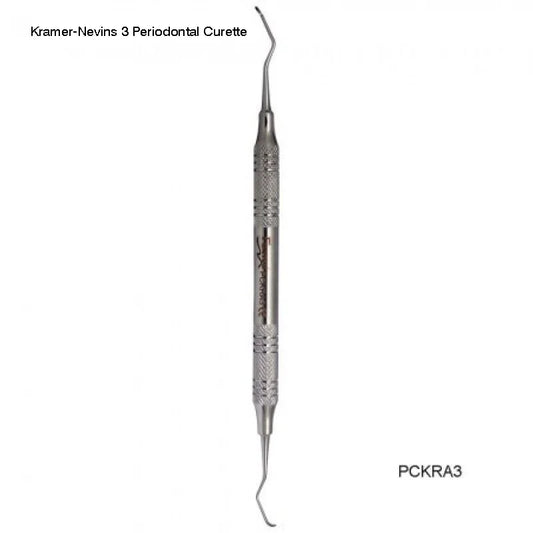
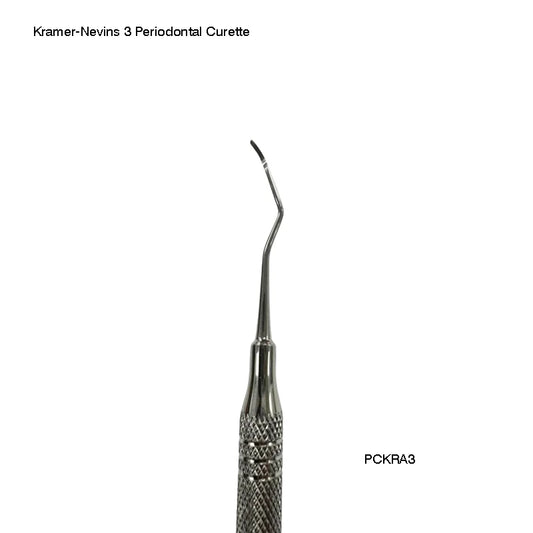
Fortec's Periodontal Curettes collection currently features 4 models, all from the Kramer-Nevins series: the Kramer-Nevins 1 Periodontal Curette ($21.99), the Kramer-Nevins 2 Periodontal Curette ($21.99), the Kramer-Nevins 3 Periodontal Curette ($19.99), and the Kramer-Nevins 3/4 Periodontal Curette ($23.99). All 4 instruments are currently in stock with large quantities available. The Kramer-Nevins series is a well-established area-specific curette design widely used in periodontal maintenance and active therapy for subgingival scaling and root planing.
A periodontal curette is a subgingival scaling instrument with a rounded toe, a curved blade, and two cutting edges — one on each lateral surface. The rounded toe allows safe insertion into the periodontal pocket without lacerating soft tissue, and the curved blade conforms to the root surface contour for thorough subgingival debridement and root planing. A sickle scaler, by contrast, has a pointed toe and a triangular cross-section, making it effective for supragingival calculus removal but unsafe for subgingival use in deep pockets where the pointed tip could traumatise the tissue. Curettes are therefore the instrument of choice for any subgingival scaling, root planing, and periodontal maintenance work.
The Kramer-Nevins series is an area-specific curette system designed for targeted subgingival access to particular tooth surfaces and sextants. The Kramer-Nevins 1 is designed for use on the facial and lingual surfaces of anterior teeth, with a shank angulation suited to direct access from the labial and lingual approaches. The Kramer-Nevins 2 mirrors the 1 but is angled for the opposite proximal surfaces of anterior teeth, completing coverage of the anterior sextant as a pair. The Kramer-Nevins 3 is adapted for posterior sextants, with a longer, more angled shank that reaches premolar and molar surfaces. The Kramer-Nevins 3/4 is a double-ended instrument that combines two complementary blade angles on one handle for efficient posterior access without switching instruments.
The Kramer-Nevins 3 ($19.99) is a single-ended instrument with one working blade, designed for a specific surface and direction in the posterior sextant. It is used alone and then set down when the clinician needs to work from the opposite approach. The Kramer-Nevins 3/4 ($23.99) is a double-ended instrument — it carries the Kramer-Nevins 3 blade on one end and the Kramer-Nevins 4 blade (the mirror-image posterior counterpart) on the other. This means the clinician can flip the instrument to access both the mesial and distal proximal surfaces of posterior teeth without placing the instrument down and picking up a second one. The 3/4 is the more efficient choice for busy periodontal practices where reducing instrument exchanges speeds up treatment.
Both Kramer-Nevins and Gracey curettes are area-specific curette systems — meaning each instrument number is designed for particular tooth surfaces rather than the whole mouth. The key difference lies in the blade offset angle: Gracey curettes have an offset blade angled at approximately 70° to the lower shank, with only the lower cutting edge used for subgingival scaling. Kramer-Nevins curettes have a more upright blade design that some clinicians find easier to adapt, particularly in anterior sextants and shallower pockets. The choice between systems is largely one of clinician preference, training background, and the specific pocket depths being treated — many practices use both. Fortec also carries Periodontal Curettes and Universal Curettes to complement your scaling tray setup.
Yes. Kramer-Nevins periodontal curettes are designed for both subgingival scaling and root planing in a single instrument. During scaling, the cutting edge is used to dislodge and remove calculus deposits and bacterial biofilm from the root surface within the periodontal pocket. During root planing, the same blade is used with lighter, more controlled strokes to smooth and detoxify the cementum surface, creating a biologically compatible root surface that supports re-attachment of periodontal tissues. The instrument transitions seamlessly between these two functions depending on the pressure, stroke length, and angulation applied by the clinician — no instrument change is required.
All Fortec periodontal curettes are manufactured from high-grade, heat-treated stainless steel that is hard enough to hold a sharp cutting edge through extended clinical use while remaining tough enough to resist fracture under normal scaling forces. The blades are precision-ground and factory-sharpened to the correct bevel angle before dispatch. In clinical use, curette blades gradually dull with each patient — a dull curette requires more pressure and is less effective at calculus removal. Fortec curettes are designed to be resharpened using standard sharpening stones (flat Arkansas stone, ceramic stone, or sharpening cone) between sterilization cycles to restore blade acuity and prolong the instrument's working life. Every instrument is individually inspected for edge quality before leaving the facility.
Yes. All four Kramer-Nevins curettes are fully compatible with standard steam autoclave sterilization and are built for long-term reuse across many years of clinical practice. The stainless steel construction maintains blade geometry, handle integrity, and surface finish through repeated high-temperature sterilization cycles without corrosion, warping, or dimensional change. To maximise instrument lifespan, rinse curettes immediately after each use to prevent calculus debris and biofilm from hardening on the blade, avoid abrasive scrubbing pads that can scratch the surface, and store instruments in a cassette or tray to prevent blade-to-blade contact during sterilization. Full protocols are available in Fortec's Instruments Care and Maintenance Care guides.
Fortec periodontal curettes are certified to four major quality and regulatory standards: CE Certified (European conformity for medical devices), ISO 9001 (quality management systems), ISO 13485 (medical device quality management), and FDA Compliant (U.S. Food and Drug Administration). These certifications confirm that every curette is produced under a controlled, audited manufacturing process and meets strict safety, hygiene, and clinical performance requirements for use in periodontal treatment across Canada, the United States, and internationally.
Fortec Kramer-Nevins curettes are priced accessibly across the range: the Kramer-Nevins 3 Periodontal Curette (single-ended) is the most affordable at $19.99. The Kramer-Nevins 1 and Kramer-Nevins 2 are each $21.99. The Kramer-Nevins 3/4 — the double-ended posterior instrument — is $23.99, reflecting the added value of two working blades in one handle. Fortec offers free Canada-wide shipping on all orders over $195 before taxes, shipped from their Mississauga, Ontario warehouse to dental hygiene practices, periodontal offices, and dental schools across the country. Full details are on the Shipping Policy page.
Shopping cart

Your cart is empty.

Return to shop
close