

Everything distributors, clinic owners, and procurement teams need to know — types, sourcing criteria, and how to choose the right supplier.
Precision is non-negotiable in implant dentistry. A placement that is even one millimeter off can affect occlusion, aesthetics, and long-term osseointegration. That is why the tools you use to measure — before, during, and after placement — matter as much as the implant itself.
Implant gauges are among the most sourced precision instruments in dental procurement, and yet they are among the least well understood by buyers who are not working chairside. This guide is written for distributors, procurement managers, and clinic owners who want to make better sourcing decisions. We will break down what these instruments are, what types exist, what to look for in a supplier, and why choosing a best-quality supplier matters at every level of the supply chain.
What Are Implant Gauges?
Dental implant gauges are precision measurement instruments used in implantology and oral surgery to assess bone depth, measure distances between anatomical structures, determine implant sizing, and verify placement accuracy. They are fundamentally different from standard explorers and probes — while those instruments detect texture and pocket depth in periodontal care, implant gauges are engineered for spatial accuracy in surgical environments.
These instruments must meet tight manufacturing tolerances. A gauge that reads 1mm off is not a minor inconvenience — it can mean the difference between a successful placement and a costly complication. That demand for accuracy is what drives the sourcing criteria that matter for both clinical buyers and wholesale distributors.
Types of Implant Gauges Every Buyer Should Know
The implant gauge category encompasses several distinct instrument designs. Understanding the differences helps you stock the right range for your customer base or clinical needs.
1. Bone Caliper / Castroviejo Caliper
The Castroviejo caliper is the most recognized instrument in this category. It features two opposing measuring tips connected by a locking screw mechanism and a calibrated scale — typically in 0–20mm or 0–40mm ranges. Surgeons use it to measure soft tissue thickness, bone crest width, and anatomical distances before and during implant placement. The locking function allows the measurement to be held and transferred to implant sizing guides. Available in stainless steel, and in some cases with anodized titanium handles for reduced weight.
2. Bone Depth Gauge / Implant Depth Gauge
These instruments feature a thin shaft with graduated markings — similar in appearance to a periodontal probe but engineered to a higher tolerance for surgical use. They are used to measure the depth of an osteotomy site to ensure the preparation matches the intended implant length. Markings are usually at 2mm or 3mm intervals, up to 20mm or beyond. Handle design matters here — surgeon ergonomics during drilling sequences make a gripped, balanced handle important for accurate depth registration.
3. Implant Locator Pin Gauge
Locator pin gauges are thin, rigid instruments used to mark or verify the position of implant sites relative to surrounding anatomy. Commonly used in conjunction with surgical guides, they allow surgeons to confirm that the site position corresponds to the planned placement. These are precision tools — the tip must be true and rigid, and the shaft must be straight within tight tolerances to provide accurate location feedback.
4. Endo Ruler / Span Measure Scale
Endo rulers are flat, rigid instruments with precise calibration markings used to measure root canal lengths and instrument spans. In implant planning, they are used to reference distances on radiographs or within the surgical field. Accurate, non-corrosive, and autoclavable — they are a workhouse measurement tool in both endodontic and implant preparation workflows.
5. Ridge Width Gauge
Ridge width gauges are used to measure the mesiodistal or buccal-lingual width of the residual ridge before implant placement. This assessment is critical for selecting the correct implant diameter and for planning any necessary bone augmentation. These instruments often have angled working ends to reach posterior ridges comfortably without obstruction from adjacent soft tissue.
See our full collection of implant gauges available for wholesale, private label, and your clinic.
Check Our Whole Collection →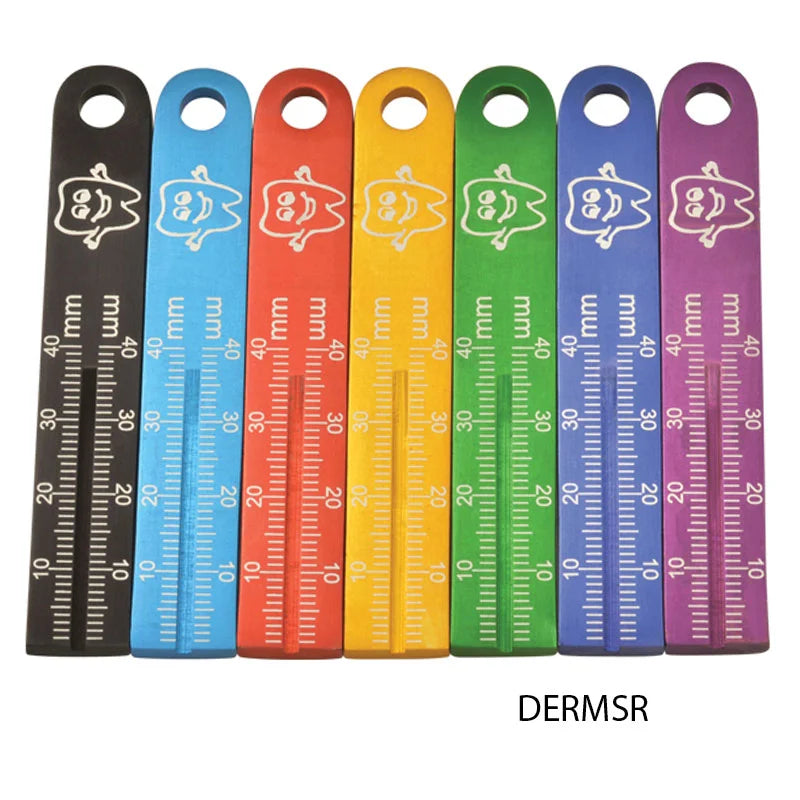


What to Look for When Sourcing Implant Gauges?
Whether you are equipping a surgical clinic or building a wholesale catalogue, the quality criteria for implant gauges are non-negotiable. Before you check dental products, here is what to evaluate.
- Measurement Accuracy and Calibration — The markings must be laser-etched or precisely ground, not painted or silkscreened. Verify the measurement range against the stated specifications before committing to volume orders.
- Material Grade — Surgical-grade stainless steel is the standard. For high-end catalogues, titanium or titanium-coated handles offer reduced weight and corrosion resistance through aggressive autoclave cycles.
- Autoclave Compatibility — Every instrument must be validated for repeated steam sterilization. Ask for sterilization cycle ratings, not just a general "autoclavable" label.
- Regulatory Compliance — Look for ISO 13485 certified manufacturing and CE or FDA clearance documentation. This is required for clinical use in Canada, the EU, and the US.
- Locking Mechanism Quality (for calipers) — The locking screw on a caliper must hold the measurement position without slipping and must resist the torque of repeated use without stripping.
Ergonomic Feel
An implant gauge that is awkward to hold or read mid-procedure creates clinical risk. Surgeons wearing medical gloves need instruments with adequate handle diameter, tactile grip, and comfortable scale visibility. This is particularly relevant for calipers used in the posterior region where access is limited.
Packaging and Sterility Presentation
For distributors, how an instrument is packaged matters to your customers. Instruments sold in individual pouches or sterile-ready presentation command better pricing and reduce clinic prep time. Dental disposables and consumables that complement reusable gauges are also worth stocking alongside them — complete kitting increases per-order value.
Market Considerations for Distributors and Wholesalers
If you are sourcing implant gauges for resale rather than direct clinical use, the analysis extends beyond instrument quality into catalogue strategy and margin management.
Who Is Your End Buyer?General dental practices buy implant gauges in small quantities — typically one or two of each type per operatory. Oral surgery practices and implant-focused clinics buy in higher volumes and expect consistent quality. Dental schools need large quantities and may prefer different packaging configurations. Each segment has different pricing sensitivity and service expectations.
Private Label OpportunitiesImplant gauges are well-suited to private-label programs. The instruments themselves are relatively standardized in design — variation comes in material grade, handle finish, and calibration range. Distributors building a house brand can differentiate on quality tier, packaging presentation, and case studies without needing to design a proprietary instrument from scratch.
Reorder Frequency and Stock PlanningUnlike scalers or burs, implant gauges are not consumables — they don't need regular replacement under normal use. This means initial orders tend to be larger, and reorder cycles are longer. Plan your inventory accordingly and focus on qualifying buyers who will become consistent customers rather than one-time purchasers.
Regulatory Documentation for Export MarketsIf you are distributing into Canada or the United States, your supplier must provide ISO 13485 certification and CE or FDA documentation. Health Canada requires medical device establishment licences for distributors selling class II or higher devices. Make sure your supplier can support your compliance requirements before committing to volume agreements.
Why Choose Fortec as Your Implant Gauge Supplier?
Fortec International has been supplying dental professionals and distributors across Canada with precision instruments for years. Our implant gauge range is built to meet the demands of surgical environments — accurate, durable, and compliant.
Surgical-Grade Materials
Stainless steel instruments with laser-etched calibration markings and validated autoclave compatibility across the full product range.
Regulatory Documentation
ISO 13485 and CE certification documentation available to support your compliance requirements in Canadian and international markets.
Private Label Options
Build your brand on instruments your customers can trust. Fortec's private-label program supports custom packaging, branding, and tiered pricing.
Canadian Stock and Delivery
No border delays. Instruments ship from within Canada, with reliable lead times and no surprise duties or customs complications.
Wholesale and Volume Pricing
Competitive pricing at volume — whether you're equipping a single operatory or stocking a distribution catalogue.
Supplier Expertise
We understand the instruments we sell — material specifications, clinical application, and sterilization requirements. Not just a box-shipper.
Add Precision You Can Trust to Your Catalogue
Ready to add precision you can trust? Contact Fortec for wholesale pricing and private label options today.
Contact Us for a Free Quote →Conclusion
Implant gauges are small instruments with outsized clinical consequence. Getting the measurement right is not optional in implant dentistry — it is the foundation of everything that follows. For buyers at every level of the supply chain, that reality should drive sourcing decisions toward quality, compliance, and supplier reliability over price alone. With the right range in your catalogue and the right supplier behind it, implant gauge procurement becomes a competitive advantage rather than a commodity transaction.
Frequently Asked Questions
What is an implant gauge used for in dentistry?
Implant gauges are precision instruments used to measure bone depth, ridge width, osteotomy depth, and distances between anatomical structures during implant planning and placement surgery. They ensure that implant sizing and positioning matches the surgical plan.
What is the difference between a Castroviejo caliper and a bone depth gauge?
A Castroviejo caliper measures distances between two points — such as bone crest width or soft tissue thickness — using two opposing tips with a locking mechanism. A bone depth gauge measures the depth of an osteotomy site using a single shaft with graduated markings, similar to a probe but engineered to surgical tolerances.
Are implant gauges autoclavable?
Yes — all quality implant gauges are designed for steam autoclave sterilization. Look for instruments validated for the specific cycle temperatures and pressures your sterilizer uses, and confirm that locking mechanisms and calibration markings remain stable through repeated cycles.
What certifications should I look for when sourcing implant gauges wholesale?
Look for ISO 13485 manufacturing certification and either CE marking for EU/Canadian compliance or FDA clearance for US distribution. For Canadian distributors, confirm that the supplier's instruments meet Health Canada medical device requirements.
Can implant gauges be private labelled?
Yes. Implant gauges are well-suited to private-label programs. The core instrument design is standardized, so differentiation happens through material grade, handle finish, packaging, and brand presentation. Fortec offers private-label options for distributors building house brands.


Leave a comment