
11 products

Fortec Dental Instruments • Impression Trays

Dental Impression Trays – Durable, Autoclavable & Precision-Fit Stainless Steel Trays for Every Arch

At Fortec International, our Dental Impression Trays are manufactured from medical-grade stainless steel to deliver accurate, distortion-free impressions for prosthodontic, orthodontic, and restorative procedures. Whether capturing a full-arch maxillary impression, preparing diagnostic casts, or recording bite registrations — these trays provide a stable, rigid foundation with superior material retention across all impression media. Available in Small, Medium, Large, and Extra Large for both upper and lower arches — CE, ISO 9001, ISO 13485, and FDA certified, fully autoclavable, and trusted by dental professionals across Canada.

Why Choose Fortec Stainless Steel Impression Trays

Fortec impression trays are built for dental professionals who demand precision, reliability, and long-term value. From full-arch crown and bridge impressions to orthodontic model preparation and partial denture records — these trays deliver a rigid, distortion-free platform that supports consistent impression quality while withstanding the demands of high-volume sterilization in busy clinical environments.

  • Medical-grade stainless steel construction that maintains its shape through repeated high-temperature autoclave cycles without warping, bending, or corrosion.
  • Superior material retention with perforated and rim-lock designs that enhance grip with alginate, PVS, and polyether impression materials, preventing slippage during setting.
  • Upper & lower arch specific designs — maxillary trays feature a deep palatal vault for full coverage, while mandibular trays provide proper lingual clearance for stable, comfortable seating.
  • Smooth, rounded borders with carefully contoured profiles that reduce soft tissue pressure and ensure complete dental arch coverage for patient comfort.
  • Fully autoclavable and reusable — cost-effective over time with reduced per-impression cost, ideal for high-volume clinics, labs, and universities.

Equip Your Clinic with Gold-Standard Impression Trays

Whether you are stocking a new operatory or upgrading your existing impression tray set, choose Fortec Stainless Steel Impression Trays — rigid, autoclavable, and available in every size for upper and lower arches. Trusted by dental professionals across Canada who demand accurate impressions and reliable instrument performance in every procedure.

FAQ – Impression Trays | Fortec Canada

Frequently Asked Questions

Everything you need to know about Fortec's stainless steel impression trays — sizes, arch types, sets, clinical uses, and care.

Fortec carries 11 stainless steel impression tray products in two categories:

Upper & Lower Sets (one of each arch per set):
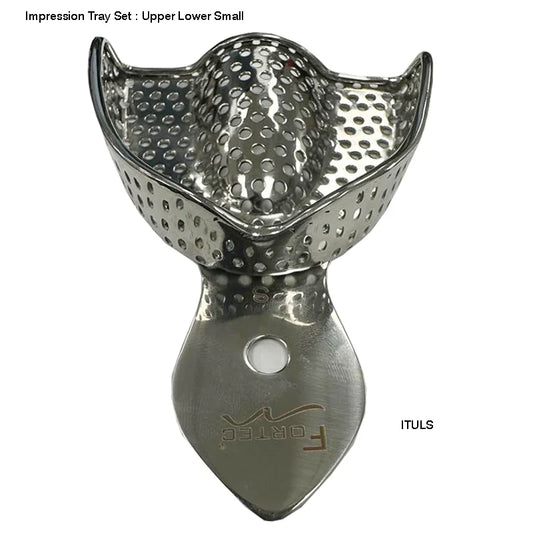
Impression Tray Set Small: Upper & Lower — $18.99
Impression Tray Set Medium: Upper & Lower — $18.99
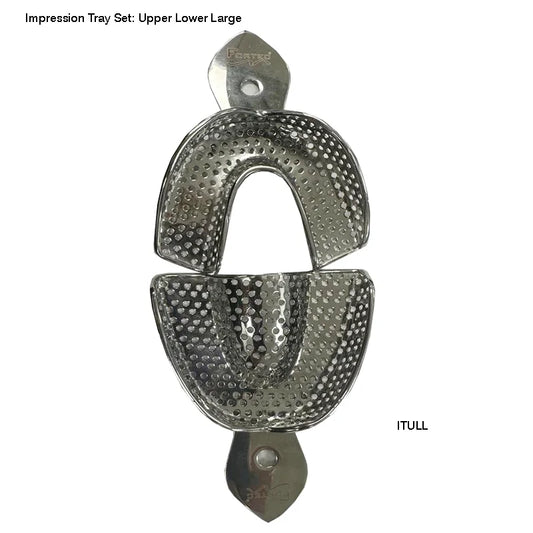
Impression Tray Set Large: Upper & Lower — $18.99

Individual Trays (single arch, all $10.99 each):
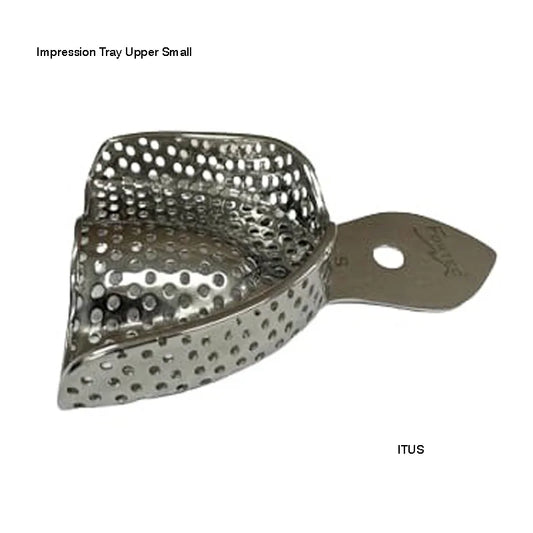
Impression Tray Upper Small — $10.99
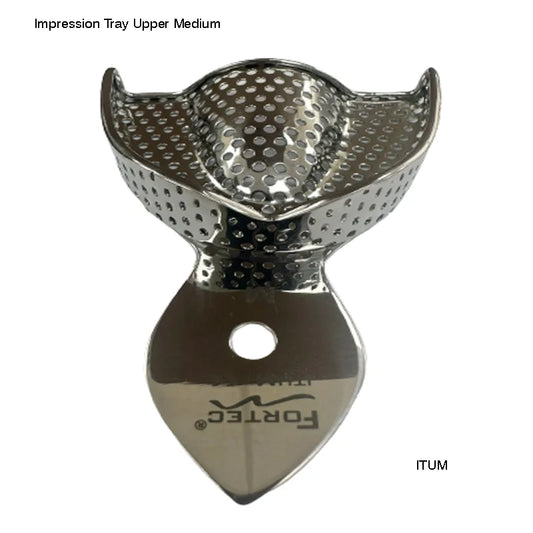
Impression Tray Upper Medium — $10.99
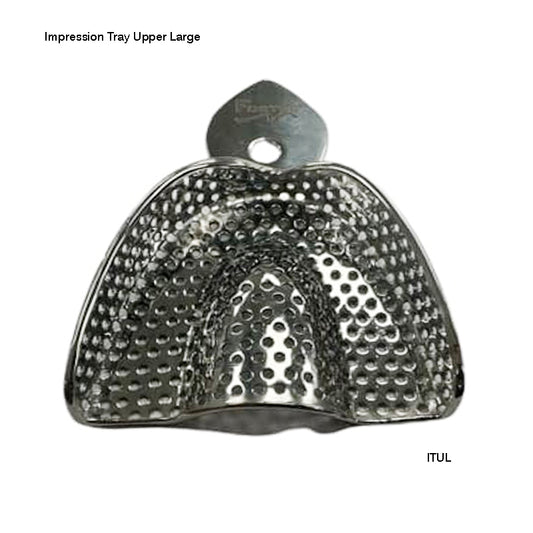
Impression Tray Upper Large — $10.99
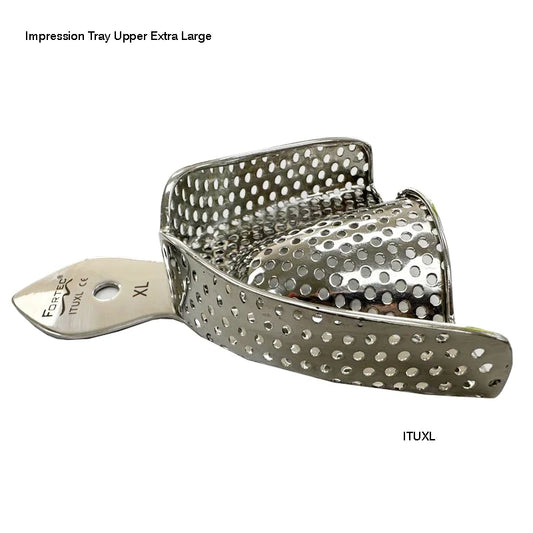
Impression Tray Upper Extra Large — $10.99
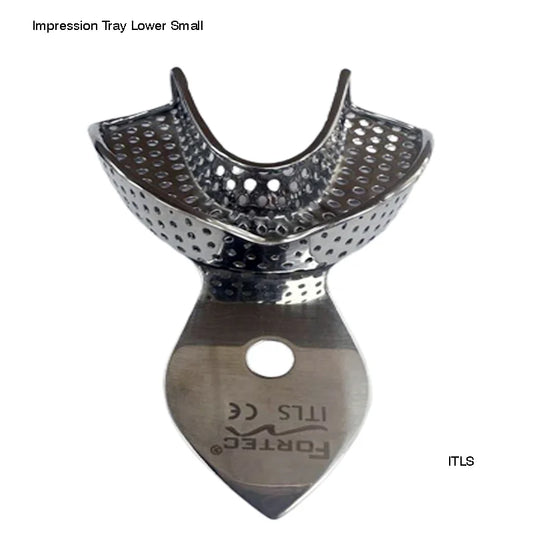
Impression Tray Lower Small — $10.99
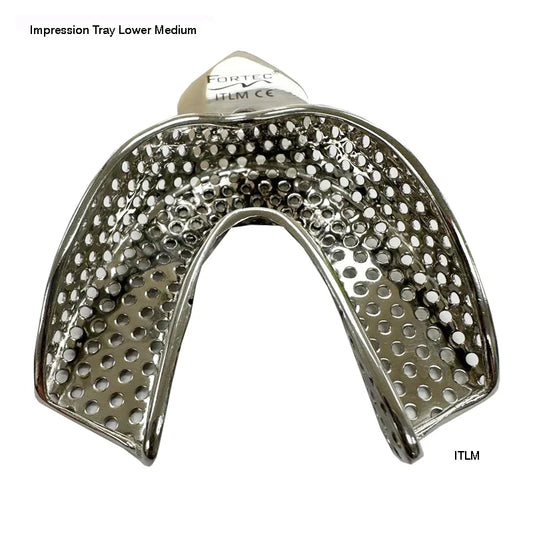
Impression Tray Lower Medium — $10.99
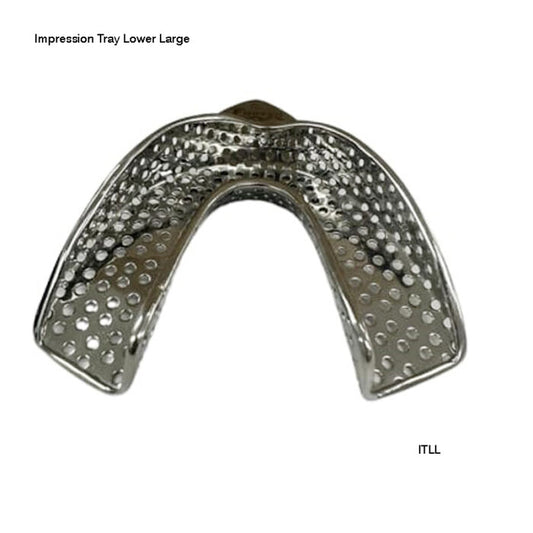
Impression Tray Lower Large — $10.99
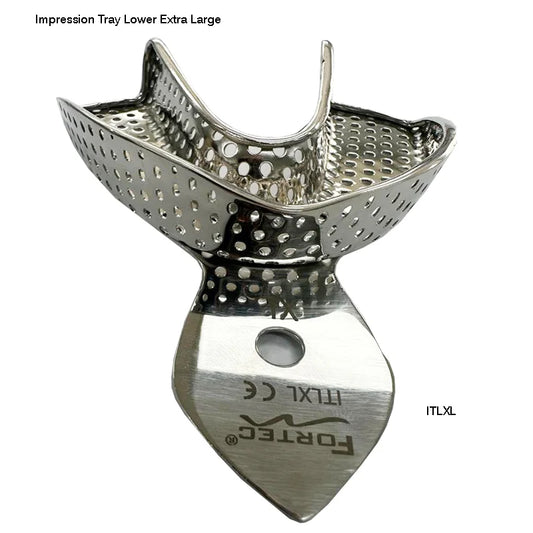
Impression Tray Lower Extra Large — $10.99

All trays are made from medical-grade stainless steel, fully autoclavable, and in stock for immediate order across Canada.
Stainless steel trays remain the gold standard for clinical impression taking for several key reasons. First, rigidity — the steel walls do not flex or warp during impression material setting or removal, which is critical for dimensional accuracy. Plastic trays can distort under the elastic recovery forces of PVS or polyether materials, introducing inaccuracy that compromises the fit of the final restoration. Second, reusability — properly sterilised stainless steel trays last for years, reducing per-impression cost significantly compared to disposable alternatives. Third, superior material retention — stainless steel trays resist pullout forces far more reliably, preventing impression material from separating from the tray during removal. Finally, sterilisation compatibility — unlike some plastics that degrade under repeated autoclave cycles, Fortec's stainless steel trays maintain their shape, surface finish, and structural integrity indefinitely through repeated sterilisation.
Upper and lower impression trays have distinctly different shapes engineered to match the anatomy of each arch:

Upper (Maxillary) Trays feature a deep palatal vault — the curved roof section that accommodates the hard palate — and higher flanges on the buccal sides to capture the full maxillary arch including tuberosity areas. This deeper, broader U-shape with palatal coverage ensures that alginate, PVS, or polyether material flows evenly over all maxillary teeth and the palate, capturing complete anatomical detail for crowns, bridges, full dentures, and orthodontic study models.

Lower (Mandibular) Trays have a flatter, narrower profile with a central channel or clearance for the tongue and floor of the mouth, and adequate lingual flange depth to capture the full mandibular arch and retromolar pads without triggering a gag reflex or impinging on sublingual tissue. Their shape provides stable seating throughout material setting and removal.

Using the correct arch-specific tray is essential — upper and lower trays are not interchangeable.
Fortec offers impression trays in four sizes — Small, Medium, Large, and Extra Large — for both upper and lower arches. Choosing the correct size is one of the most important steps in taking an accurate impression:

The tray should extend at least 3–5mm beyond the most distal tooth (including the tuberosity or retromolar pad) and the flanges should clear the buccal mucosa by the same margin — enough to allow a uniform impression material thickness on all sides without the tray walls touching the teeth or gingiva. A tray that is too small will not cover all teeth or the posterior landmarks; one that is too large will seat too deeply and distort soft tissue.

As a starting guide: Small for narrow arches, pediatric patients transitioning to adult trays, or patients with significant tooth loss reducing arch width; Medium for the majority of adult patients; Large for broad or square arches common in adult males; Extra Large for very wide arches or patients where a Large tray does not provide adequate posterior coverage. Always try the tray in the mouth dry before loading impression material to confirm fit.
The Impression Tray Sets ($18.99 each) — available in Small, Medium, and Large — each include one upper tray and one matching lower tray of the same size, packaged together. At $18.99 per set, this is significantly more cost-effective than purchasing the two individual trays separately (2 × $10.99 = $21.98), representing a saving of nearly $3.00 per size.

Choose sets when setting up a new surgery, stocking a dental school simulation clinic, equipping multiple operatories simultaneously, or when you consistently use the same size for both arches on the same patient visit — which is the case for most full-arch impression procedures (dentures, orthodontic records, study models).

Choose individual trays when you need to replace a single worn tray, when upper and lower arches require different sizes for a particular patient population (common in practices with a specific case mix), or when the Extra Large size is needed — which is available as an individual tray only and is not included in the current set range.
Fortec stainless steel impression trays are compatible with all standard dental impression materials used in clinical practice:

Alginate (irreversible hydrocolloid) — the most commonly used material for study models, orthodontic records, opposing arch impressions, and diagnostic casts. Alginate adheres well to perforated or rim-lock tray designs and sets quickly, making stainless steel trays with adequate perforations or border features the ideal carrier.

Polyvinyl siloxane (PVS / addition silicone) — the gold standard for crown, bridge, implant, and fixed prosthodontic impressions. PVS requires an adhesive applied to the tray surface before impression taking to prevent material separation during removal. Stainless steel's rigid walls are essential for the dimensional accuracy PVS can deliver.

Polyether — similar application to PVS, with higher stiffness on set requiring firmer removal; rigid steel trays handle these removal forces without distortion.

Zinc oxide eugenol (ZOE) paste — used for edentulous final impressions and denture border moulding procedures.

For PVS and polyether materials, apply the manufacturer-recommended tray adhesive to the clean, dry tray interior at least 5 minutes before loading to ensure reliable material retention.
Fortec stainless steel impression trays support a broad range of dental procedures across multiple disciplines:

Prosthodontics — full-arch impressions for complete and partial dentures, crowns, bridges, and implant-supported restorations requiring accurate working models.

Orthodontics — study model impressions for treatment planning, appliance fabrication (retainers, aligners, expanders), and pre- and post-treatment records.

Restorative dentistry — opposing arch impressions to articulate working models, bite registrations, and diagnostic casts for treatment planning complex restorative cases.

Oral surgery — pre-surgical study models for implant planning, bone grafting assessment, and surgical guide fabrication.

General diagnosis — baseline diagnostic casts, monitoring of wear facets, tooth movement, and periodontal changes over time.

The full size range from Small to Extra Large ensures appropriate tray selection across all patient demographics from adolescents to adults with large arches.
Fortec stainless steel impression trays feature a perforated design — the tray floor and walls contain a pattern of precision-stamped holes that allow impression material to mechanically lock through the perforations as it sets, creating a strong physical bond between the material and the tray without requiring adhesive for alginate impressions. This is the most widely used tray style in general dentistry globally.

For alginate, perforated trays provide excellent mechanical retention and no additional adhesive is needed — the material simply flows through the perforations during loading and locks in place on setting.

For PVS and polyether materials, the perforations alone are not sufficient for reliable retention given the higher elastic recovery forces involved during impression removal. Tray adhesive must be applied to the interior surface and allowed to dry before loading these materials, even on perforated stainless steel trays. This is standard clinical protocol and applies to all tray types with these materials.
After each use, remove all residual impression material from the tray immediately — alginate in particular begins to adhere firmly if allowed to dry. Rinse under running water and use a soft brush or instrument to clear material from the perforations, ensuring no residue remains that could compromise the next impression's accuracy or act as a biofilm reservoir. Avoid sharp metal scrapers on the tray surface, which can scratch the stainless steel and create areas where impression material may adhere differently in future impressions.

If tray adhesive was used for PVS or polyether impressions, remove all adhesive residue completely before sterilisation — dried adhesive in the perforations reduces retention for subsequent uses.

Autoclave sterilisation is the recommended and fully supported method for all Fortec stainless steel impression trays. The medical-grade stainless steel maintains its shape, surface finish, and structural integrity through repeated sterilisation cycles without warping, corroding, or degrading. For complete care protocols, refer to Fortec's Instruments Care and Maintenance Care guides.
Yes — Fortec offers free Canada-wide shipping on all orders over $195 before taxes, shipping from their warehouse at 1011 Hualtain Court, Unit 14, Mississauga, Ontario, L4W 1W1. Impression tray prices range from $10.99 per individual tray to $18.99 per upper and lower set. Stocking a full size range across multiple sets reaches the free shipping threshold quickly, and combining trays with other endodontic or restorative instruments from the Fortec catalogue makes ordering even more efficient. All 11 products are in stock and available for immediate order at fortec.ca. Fortec's customer care team is available Monday to Friday, 8:00 AM – 4:00 PM at 1-855-790-7779 or at info@fortec.ca for order assistance. Full details are on the Shipping Policy page.
Shopping cart

Your cart is empty.

Return to shop
close